
BRAILLE SIGNAGE
Get a Quick Quote

Discover the Power of Braille Signage in Creating Accessible Environments
This topic is dedicated to raising awareness on exploring the resources, insights and innovative braille signage solutions to make a positive impact in our community. By incorporating braille signage in public spaces, we can create an environment that values and supports the independence and confidence of visually impaired individuals, enhancing their quality of life and ensuring equal opportunities for all.


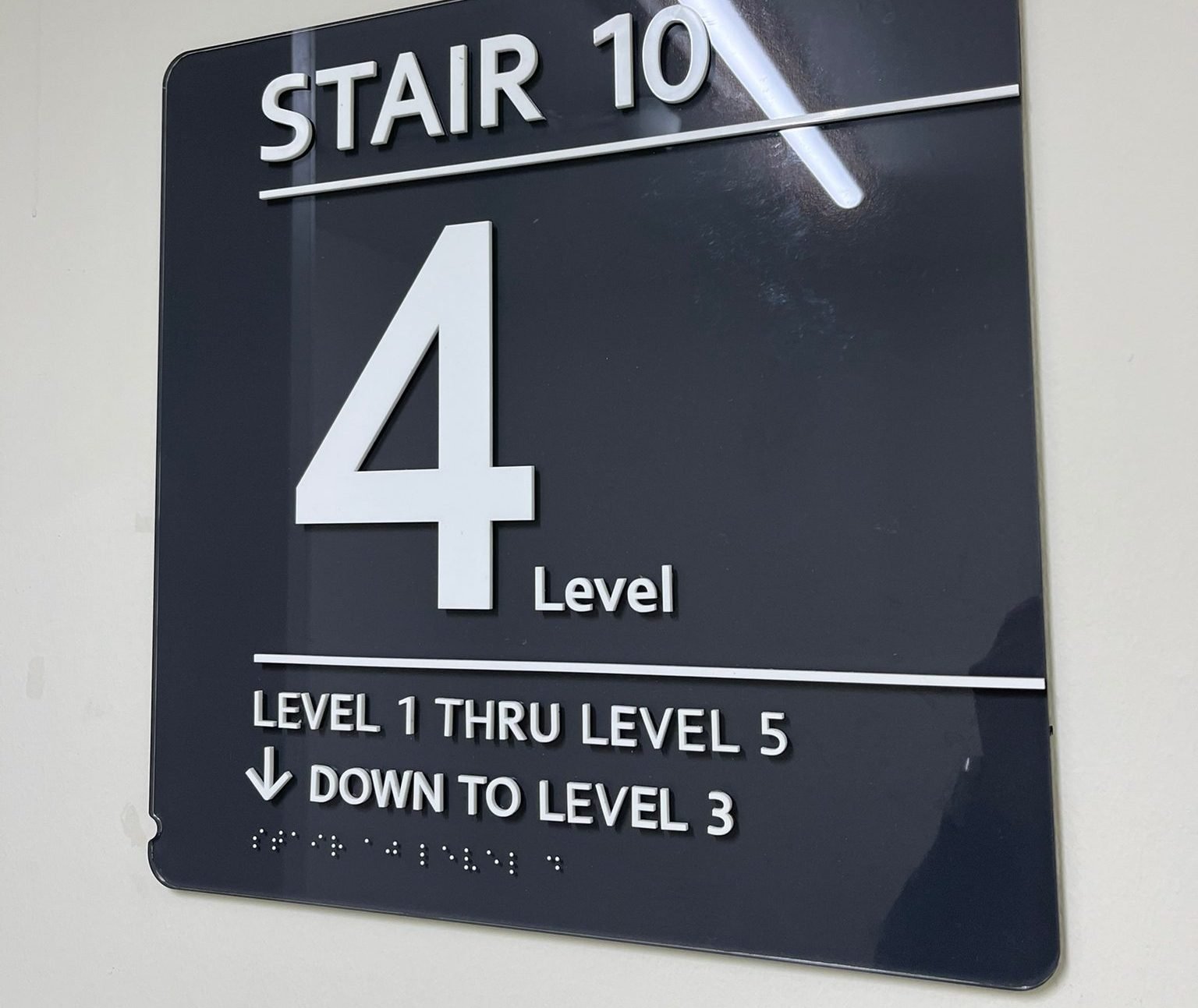


Braille is a unique and invaluable tactile writing system designed to facilitate communication and literacy for individuals who are blind or have severe visual impairments. Created by Louis Braille in the early 19th century, it has since become the most widely used method of written communication for the visually impaired.
The foundation of Braille lies in a grid of six raised dots, arranged in two columns with three dots in each column. These dots can be combined in various ways to represent letters, numbers, punctuation marks, and even musical notes. A single Braille cell can convey 63 different characters.
To read Braille, individuals use their sense of touch. By running their fingers over the raised dots on a Braille page or a Braille display, they can perceive and interpret the characters and words. Writing in Braille can be done using tools like a stylus or a mechanical Braille writer, which embosses the dots onto paper, creating the raised surface that can be read by touch.
Braille literacy is of utmost importance for people with visual impairments, as it grants them access to written information, education, and employment opportunities. By mastering Braille, individuals can independently read books, textbooks, menus, signs, and other written materials.
In addition to the standard Braille system, there are specialized versions for different languages and purposes. For instance, Unified English Braille (UEB) is used for English-language materials, while specific Braille codes exist for mathematics, music, and computer notation.
Despite advancements in technology and the availability of text-to-speech software, Braille remains an indispensable skill. It empowers individuals with visual impairments, enabling them to communicate, learn, and engage with the world through the sense of touch.
Braille signage plays a crucial role in ensuring accessibility and inclusivity for individuals with visual impairments. It allows them to navigate public spaces independently and access important information. There are several types of Braille signage commonly used, each serving different purposes. Let’s explore some of them.
- Wayfinding Braille Signs
Wayfinding signs are used to provide directions and guide people through various locations. In Braille signage, these signs typically incorporate both tactile symbols and Braille characters. Tactile symbols help individuals understand the purpose or category of a particular area, such as restrooms, elevators, or exits. Braille text accompanies these symbols to provide detailed information. - Informational Braille Signs
Informational signs convey essential information, such as building names, room numbers, or safety instructions. In Braille signage, these signs usually feature raised text and Braille characters. The raised text allows visually impaired individuals to read the information through touch, while Braille characters offer an additional reading option. - Warning and Safety Braille Signs
Warning and safety signs are crucial for alerting individuals about potential hazards and providing instructions to ensure their safety. In Braille signage, these signs may include raised symbols or pictograms that indicate dangers like fire exits, emergency exits, or cautionary messages. Braille characters can accompany these symbols to provide specific details or instructions. - Public Transport Braille Signs
Public transportation systems often use Braille signage to assist visually impaired passengers. Braille signs in bus stops, train stations, and airports can provide information about platforms, departure times, and other relevant details. These signs may include tactile maps, raised symbols, and Braille characters to aid navigation and communication. - Educational Braille Signs
Educational institutions frequently use Braille signage to promote inclusivity and facilitate independent learning for visually impaired students. Braille signs in schools, universities, and libraries can identify classrooms, offices, or specific areas like computer labs or libraries. These signs are designed to be easily located and understood, enabling visually impaired students to navigate the educational environment effectively. - BCA Compliant Braille Signs
Braille signage is an essential component of compliance with the BCA. A BCA-compliant signs follow specific guidelines to ensure uniformity and readability. These signs incorporate raised letters and Braille characters, and they often feature high color contrast to enhance visibility for individuals with low vision.
In conclusion, Braille signage encompasses various types of signs designed to provide information, directions, warnings, and accessibility in public spaces. By incorporating tactile symbols, raised text, and Braille characters, these signs empower visually impaired individuals to navigate their surroundings independently and access important information, promoting inclusivity and equal opportunities for all.
Retail advertising: If you’re a commercial establishment looking to attract more walk-in customers off the road or help your loyal customers find your store easier, you’ll likely want to use custom signs to accomplish these goals. Signage can support internal and external lighting, indoors, or outdoors for weather conditions, and stands out equally in both daytime or nighttime.
Menu boards: If you’re in food services, you should use to make large menu boards hanging behind service counters. signs graphics can make menu options to leap bent those viewing the board, improving a customer’s experience while ordering.
Office signs: signs offer a form of decoration for office buildings. They can be placed in reception areas, hallways, or communal working spaces to be more visually appealing and also provide the necessary information clear at the same time.
Trade show exhibits: The glossy, attention-getting nature of the signboard makes it a perfect trade show option. At a fair, you’ll be vying for the eye of attendees, so standing out from the competition is paramount. You’ll be confident that custom signs will gain individuals’ vision of walking by and make your company appear more professional.
Restaurant signs: Impressions are very important when it comes to an F&B outlet. To spread awareness about your restaurant and become a premier location in your community or area, you should utilize an outstanding restaurant signboard to attract pedestrian traffic for an impromptu meal. Additionally, the signs are often designed to send a message about how casual or formal your restaurant is. Make use of attractive colors in your signage as a form of psychological marketing.
Point-of-purchase signs: Companies that use point of purchase signs will love the way acrylic is often modified. Point-of-purchase signs direct customers to a specific product during a store to encourage customers to shop for it or undertake a free sample. To urge their attention, these signs will often be customized to be as eye-catching as possible while also pointing the viewer to the merchandise. Since the sign is so customizable and flexible in the making, it’s perfect for the requirements of point-of-purchase signs.
Showroom signs: Companies that often hold auctions or sell high-level products usually use signs to spotlight the foremost appealing objects purchasable. For instance, businesses that run a car showroom will often strategically place signage near cars that dealers are trying to sell. The signs will draw attention to the vehicles while also providing information about the make, model, year, and other relevant and important information.
Directional signs: signage is additionally an incredible option for wayfinding signage. Its visually appealing nature ensures people will notice the directions and know where they have to travel. Since signs are durable, you won’t need to worry about your signs becoming damaged or obscured.
In this article, we will explore how Braille signage facilitates independence and confidence among visually impaired individuals.
- Access to Information
Braille signage serves as a bridge between visually impaired individuals and the environment around them. By converting written text into a tactile format, Braille signage allows blind individuals to access critical information such as room numbers, directions, labels, and safety instructions independently. This access to information empowers them to navigate public spaces confidently, enhancing their overall independence. - Wayfinding and Navigation
One of the most significant challenges faced by visually impaired individuals is wayfinding and navigation. Braille signage addresses this issue by providing directional cues, floor plans, and location names in tactile form. By incorporating Braille into signage systems, visually impaired individuals can orient themselves, locate specific areas or facilities, and move around unfamiliar places more efficiently. This increased spatial awareness fosters a sense of independence and reduces reliance on sighted assistance. - Equal Participation
Braille signage promotes equal participation in various aspects of life for visually impaired individuals. Whether it is educational institutions, workplaces, transportation hubs, or public facilities, the presence of Braille signage ensures that individuals with visual impairments can actively engage with their surroundings. With access to Braille signage, visually impaired individuals can independently access restrooms, identify elevator buttons, read menu options in restaurants, and interact with information kiosks, among many other activities. - Empowering Decision Making for visually impaired
By providing essential information in a tactile format, Braille signage empowers visually impaired individuals to make informed decisions. For example, in public transportation settings, Braille signage allows blind individuals to identify the correct platforms, bus stops, or train schedules, enabling them to plan their journeys confidently and safely. Similarly, Braille labels on food packaging or medication containers enable visually impaired individuals to identify products and make independent choices based on their preferences and needs. - Dignity and Social Inclusion
Braille signage not only facilitates independence but also contributes to the overall dignity and social inclusion of visually impaired individuals. It eliminates the need for constant assistance and allows them to interact with their environment on an equal footing with sighted individuals. This enhanced level of autonomy fosters self-confidence and self-esteem, enabling visually impaired individuals to participate actively in social, educational, and professional activities, thus breaking down barriers and promoting a more inclusive society.
Braille signage serves as a powerful tool that empowers visually impaired individuals by providing them with access to information, enabling wayfinding and navigation, promoting equal participation, empowering decision-making, and fostering dignity and social inclusion. By incorporating Braille signage in public spaces, we can create an environment that values and supports the independence and confidence of visually impaired individuals, enhancing their quality of life and ensuring equal opportunities for all.
Yes of course, after getting the necessary information from you and you’re interested to work with us, we can arrange an appointment to visit your site for more face-to-face efficient discussion.